Today we’re introducing Ruby, a new browser-based stem splitting app built directly into the Voclr.it ecosystem.
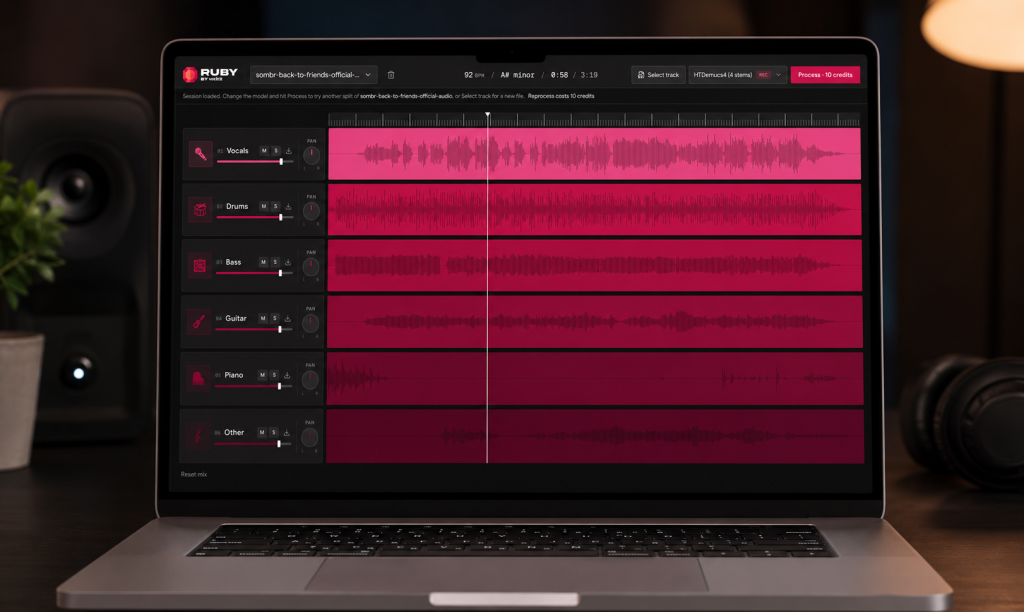
Ruby lets you upload a track, choose a separation model and split the recording into individual stems without installing software, configuring Python environments or needing a powerful GPU sitting in your studio.
The processing happens for you.
And Ruby is now included as part of a Voclr.it Pro membership.
What Is Ruby?
Stem separation has become an incredibly useful part of modern music production.
A finished stereo recording might contain vocals, drums, bass, guitars, synths and other instruments all mixed together. Stem separation uses machine learning models to analyse that recording and attempt to isolate those individual elements.
Ruby gives producers a simple way to access this technology from their browser.
Upload your audio, select the model you want to use and Ruby handles the processing.
The resulting stems can then be taken into your DAW and used for remixing, sampling, DJ edits, production, analysis and experimentation.
There’s no specialist hardware required on your side and nothing to install locally.
Multiple Open Stem Separation Models
One of the things we wanted to avoid with Ruby was locking the entire service to a single separation model.
There isn’t necessarily one model that produces the best result for every piece of music.
Different architectures can perform differently depending on the recording, genre, instrumentation and type of stem you’re trying to extract.
Ruby therefore launches with support for four popular open model families, with both 4-stem and 6-stem HTDemucs4 configurations available.
HTDemucs4 — 4 Stems
HTDemucs4 is available for traditional four-stem separation.
It separates a recording into:
Vocals
Drums
Bass
Other
This is a useful starting point for producers who want the main components of a recording separated without generating a large number of individual files.
BS Roformer
Ruby also supports BS Roformer, bringing Roformer-based source separation into the platform.
The Roformer family of models has become increasingly popular within the open source audio separation community.
Instead of producers having to download models, configure software and process everything locally, Ruby makes the model available through a much simpler browser workflow.
MelBand Roformer
MelBand Roformer is another separation option available inside Ruby.
This gives producers another architecture to experiment with when separating material.
Having multiple models becomes particularly useful when working with difficult recordings. If one model introduces artifacts or struggles to isolate a particular element, you can try the same source material with another model.
SCNet XL
Ruby also includes support for SCNet XL.
Again, the purpose is choice.
Rather than us deciding that one model should be used for everything, producers can experiment and find the model that gives them the most useful result for a particular recording.
HTDemucs4 — 6 Stems
For projects where you need more separation, Ruby also supports the 6-stem version of HTDemucs4.
Instead of stopping at the standard four broad stems, this configuration can separate additional instrument categories and give you greater control over the individual elements of a recording.
That can be particularly useful when you’re trying to rebuild, analyse or creatively manipulate a track inside your DAW.
Why We Built Ruby
Voclr.it started with a very specific purpose: help producers find acapellas.
That library has grown considerably over the years, but the way producers work with vocals and existing recordings has changed too.
Machine learning has made audio source separation significantly more accessible.
The technology itself is impressive, but actually running many of these open models isn’t always particularly accessible.
You may need Python, specific dependencies, model files, command-line tools and, depending on the model and workload, considerable GPU resources.
That’s fine for developers and people comfortable building their own audio processing environments.
Most producers just want to make music.
Ruby is our attempt to remove that technical layer.
Choose a file. Choose a model. Split it.
The complicated processing happens behind the scenes.
More Than Just Vocal Extraction
Although Voclr.it is heavily associated with vocals and acapellas, Ruby isn’t limited to extracting vocals.
Being able to access individual components of a finished recording creates all kinds of production possibilities.
You could isolate a vocal for a remix, extract drums to study a groove, remove vocals to create an instrumental, separate a bassline for analysis, pull individual elements into a sampler or use stems as the starting point for something completely different.
For producers, DJs and remixers, separation effectively gives you another way of looking inside a finished recording.
And because Ruby offers multiple models, you can process material differently depending on what you’re trying to achieve.
No Local GPU Required
This was an important part of Ruby for us.
Modern audio separation can be computationally expensive.
Running some models locally can require substantial GPU resources, particularly when processing longer recordings or running larger models.
Ruby moves that processing away from your computer.
That means you don’t need to buy a dedicated GPU just to experiment with the latest open source separation models.
You also don’t need to worry about CUDA versions, Python packages, model dependencies or command-line interfaces.
The infrastructure handles that.
Your browser becomes the interface.
Voclr.it Pro Is Becoming a Production Toolkit
Ruby is also part of a bigger change we’re making to Voclr.it.
We don’t want Pro to simply mean “more acapella downloads.”
We’re gradually building a collection of sounds, software and tools around the way producers actually work.
A Voclr.it Pro membership now gives you access to:
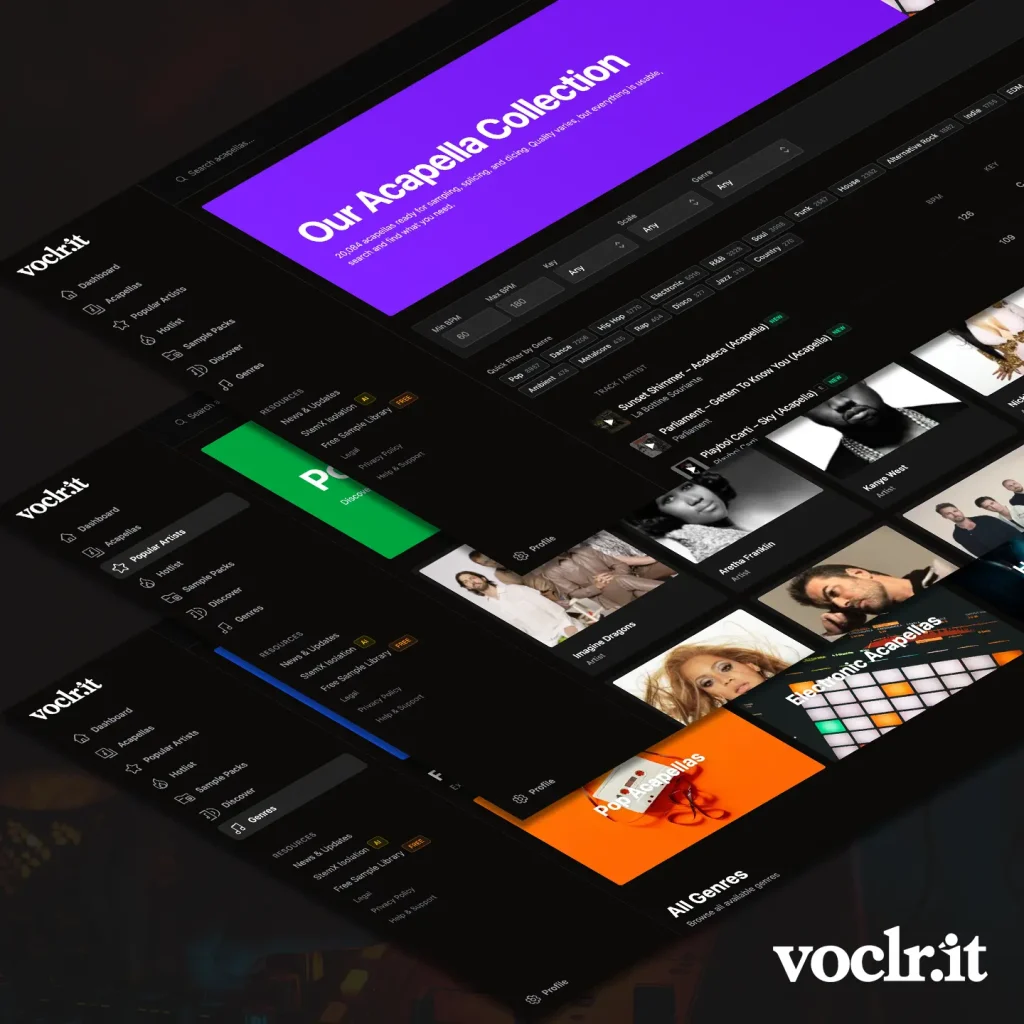
22,000+ Acapellas
Our growing library of vocals for producers, DJs and remixers.
5,000+ Old Skool One Shots
Thousands of vocal cuts, phrases, shouts, hooks and other one-shot samples, including sounds that circulated through dance music production communities for decades.
Bonfire VST
Our music production plugin, included as part of the growing Voclr.it ecosystem.
Ruby
Browser-based stem splitting with access to HTDemucs4, BS Roformer, MelBand Roformer and SCNet XL.
And we’re not finished.
Open Models, Simple Interface
There’s a huge amount of interesting work happening around open source audio and machine learning.
Researchers and developers are continually experimenting with new architectures and improving what is possible with source separation.
But there’s often a large gap between a model existing and that model being genuinely convenient for a music producer to use.
Ruby is designed to sit between those two worlds.
We can handle the infrastructure and technical implementation while producers get a straightforward interface for actually using the technology.
It also gives us room to expand Ruby as stem separation technology develops.
The Beginning of Ruby
This is the first version of Ruby.
We’ll be watching how people use the different models, where they perform well, where they struggle and what producers actually want from a browser-based separation workflow.
The aim isn’t simply to build another vocal remover.
We want Ruby to become a genuinely useful stem separation environment for music production, with access to powerful models without the technical work normally required to run them.
And because Ruby sits alongside the existing Voclr.it library, it becomes another part of a much larger production ecosystem.
Find an acapella.
Dig through thousands of old skool vocal samples.
Open Bonfire in your DAW.
Split audio with Ruby.
Then make something.
Try Ruby
Ruby is available as part of Voclr.it Pro.
If you’re already a Pro member, Ruby is included with your membership.
If you’re not, upgrading now gives you access to Ruby alongside 22,000+ acapellas, 5,000+ Old Skool one shots and Bonfire VST.
Try Ruby on Voclr.it and start splitting.